Monday, August 31, 2009

Tail Ends


And so the dog days settle to an end.

Wikipedia tells us:

The term "Dog Days" was used by the Greeks, as well as the ancient Romans, who called these days caniculares dies—days of the dogs—
after Sirius the "Dog Star" (in Latin Canicula), the brightest star in the heavens besides the Sun. The dog days of summer are also called canicular days.
The Dog Days originally were the days when Sirius, the Dog Star, rose just before or at the same time as sunrise (heliacal rising), which is no longer true, owing to precession of the equinoxes. The Romans sacrificed a brown dog at the beginning of the Dog Days to appease the rage of Sirius, believing that the star was the cause of the hot, sultry weather.

For other endings, tale ends, on this 31st day—
Consider a list or two of the greatest endings in literature;
Match endings to books yourself;
See how many of these last lines of films you remember.

And for a fitting epitaph to this dog-ridden month, wagging away into the cool, prim, light-dappled clearing of September, or slipping off with toothmarked bone in mouth and tail between its legs to lie under a shady cabin step at least 'til after Labor Day, let us have the famous last line of Scott Fitzgerald's elegiac
The Great Gatsby, also his own epitaph (the last last lines of all)—

So we beat on, boats against the current, borne back ceaselessly into the past.


image: Pierre Bonnard, Dog with Cherry Tart
http://www.scholarsresource.com

Tuesday, August 25, 2009

Figs


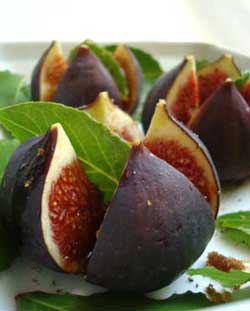
On Sunday I made my savory fig tart for a Spanish-themed picnic at Stern Grove (Italian opera, and stories from friends just back from Lucca and Puccini’s villa). Carmelized onions, goat cheese and mozzarella, crumbled bacon, fragrant fresh rosemary and thyme, and ripe purple figs halved and drizzled with Lisbon Lemon olive oil, in a healthy whole wheat pie crust.

Perfect accompanied by a lovely tortilla, potato omelette, along with charred and lightly salted pimientos de padron, mixed olives, Serano ham, and assorted Spanish cheeses— Manchego, Naked Goat, and young Mahon (from Mahón, the capital of the Balearic island of Minorca, smaller and flatter than Mallorca, and the source as well of salsa mahonesa, known to us as mayonnaise . . . )

The arias were all Italian, to welcome the arrival of the wonderful Nicola Luisotti to the San Francisco Opera— what a treat for a Sunday in a grove of temple-solemn redwoods, eucalyptus, and fir.

I especially love that the new conductor's grandfather went duck hunting with Puccini, and that Puccini came to his village to listen to the bells, which made their way into Tosca; and I love his insistence on beauty.

One of the arias we heard was one I find most beautiful in all the Italian repertoire, "Ebben? Ne andrò lontana," from the almost unknown opera by Catalani, La Wally. Here is what's perhaps my favorite recorded version, sung (as it was when I first heard it in 1981, in the film Diva) by Wilhelmenia Wiggins Fernandez. I can listen over and over and over.


images: figs from http://www.eyeonspain.com/spain-magazine/Images/figs.jpg
Tuscan platter from Montelupo, Italy, via The Pottery Co. www.thepotteryco.com

Monday, August 24, 2009

Amarillo


Happy discoveries of the weekend:

Bright yellow peppers, and purple! Impossibly purple and glossy as childhood's grape jelly, neither Han purple nor indigo nor violet, but glad purple itself—the name derived from Greek, the purple of the murex shells that dyed cloth in antiquity. A sacred color, understandably. Purple peppers and yellow, the two brilliancies juxtaposed.

Breakfast at the farmer’s market in the lot behind the post office (among the possibilities of fresh-baked bread or crêpes with cheese and ham or rolls larded with nuts and cinnamon), from the Oaxacan Kitchen, a tamale with chicken and mole amarillo wrapped in a corn husk— delicious, but apparently with no chocolate and nuts and cloves like mole negro. Instead, tomatillos, chayote squash, hierba santa, cominos, guajillo chiles . . . and corn masa (or masa harina) for the tamale dough . . . Click for mole recipes.

Then chicory, the kind found at the agora in Crete (wild greens to saute or to eat in pies,
hortopita, as the heroine of my Cretan novel, Reading the Stones, loves to); baby red chard; wild arugula; basil. Heirloom tomatoes, at what is nearly the perfect moment of the season. Local raspberries.

A woman with a parrot at a picnic in the Palo Alto Hills. A parrot of few words but also brilliant colors.


image: http://www.goinglocal-info.com/my_weblog/2008/09/preserving-swee.html

Friday, August 21, 2009

Writing with August Light


To remind myself what it is all about . . .

Color and light! The joy of seeing into the heart of things. Something the artist Pierre Bonnard said late in his life—

“Speaking, when you have something to say, is like looking. But who looks? If people could see properly, and see whole, they would all be painters. And it’s because people have no idea how to look that they hardly ever understand.”

Wherever I am, I like to coax out quiet revelations, luminous and lovely—the play of light, the journeyings of time, things ephemeral and ancient. I'm especially fascinated by the liminal space of windows, by the ambiguities of outside and in, substance and reflection, glass and what's printed on it.

This blog is an attempt to share that.


image: Christie B. Cochrell, Writing with Light collage

Tuesday, August 18, 2009

End of Summer Muse


This was to be a summer of drastic changes. I was ready to be new again. I signed up for a mystery-writing class, for chi conditioning (neither my old favorite Tai Chi nor Qigong). I began practicing Pilates, outside the Red Barn on campus where Stanford students board and school their horses, watching hawks and swallows overhead, wistful for my old love of riding, the dusty days at Santa Fe horse-shows seeing others, more daring, jump. I meant to rent a bicycle, to carry books and herbs in my basket, move slowly, drink only sage tea, become a better person, lose weight. I did finish a novel, start a long-contemplated blog.

But nothing has added up to more, or different. I am as I was before, only a short summer along. The world didn't transform for me, the way it did when I learned to tell it through photographs instead of words, or when the words returned. My spirit hasn't become gossamer butterfly. I am still bound by gravity. Now more than ever, in fact, despite finding a certain balance in the hour of Pilates up by the Red Barn, while others ride around the dusty ring.

Maybe change isn't what I was after? I've just been told that tea is said to taste much better brewed in pots that have accumulated a dark layer of sediment over the years. And in Tristes Tropiques, that marvelous journey to self, the anthropologist Claude Lévi-Strauss writes:
In Martinique, I had visited rustic and neglected rum-distilleries where the equipment and the methods used had not changed since the eighteenth century. In Puerto Rico, on the other hand, in the factories of the company which enjoys a virtual monopoly over the whole of the sugar production, I was faced by a display of white enamel tanks and chromium piping. Yet the various kinds of Martinique rum, as I tasted them in front of ancient wooden vats thickly encrusted with waste matter, were mellow and scented, whereas those of Puerto Rico are coarse and harsh. We may suppose, then, that the subtlety of the Martinique rums is dependent on impurities the continuance of which is encouraged by the archaic method of production. (chapter 38: A Little Glass of Rum)
So I'd like to think that if I'm rustic and neglected, despite my attempts to make myself over, that's all for the best. What I love accrues, adding day by day and year by year to the flavor of my after all blessedly unchanged life.


image: Christie B. Cochrell, McCloud, CA

Wednesday, August 12, 2009

Chicago postscript


But after all, my Bonnard wasn’t there.

It’s what Bonnards do—vanish into museum storerooms, go travelling suddenly across the world, without warning, without apology, taking the light with them like stained glass when the sun is gone from it.

It is a worthy occupation chasing them; something I’ve done for more than half my fifty years; a journey I’ve bequeathed to Isabel, the heroine of my Bonnard novel Nude Against the Light. Something that redeems her life.


image: Pierre Bonnard, The Seine at Vernonnet

The Windy City Without Wind


Tuesday, August 11, Chicago

A morning begun with Wild Sweet Orange tea, Tazo’s herbal infusion, and promising one of my favorite Bonnards at the Art Institute. A breeze ripples the flags along the bridge; the boats sleep, still, like houseboats on the Seine or on the river Avon.

It’s good to be back in Chicago, one of my favorite big-city away-from-homes (along with Boston’s Back Bay, midtown Manhattan, and Washington, DC up near the cathedral and zoo).

Despite the early hour, it’s pleasant to walk to work along the green river, under a lofty drawbridge, with architecture tour boats moored quietly along the opposite bank, impressive buildings rising all around. To see the reflection of sky and clouds in the new Trump International Hotel, on my way to the Corner Bakery for decaf espresso and croissants. Then later in the day, sprung from the windowless, timeless exhibit hall, it’s reviving to see the play of fireboats and water taxis on their journeys to and from the lake, to sit with sandwich and notebook watching the wakes erasing as they go and the contemplative sparkle of sun. And when the night comes on again the enchantment of lights reflected, multiplied, and with them unarticulated yearnings for things past or out of reach, the far places in me I long for and am always already leaving again.

So many momentous things have happened to me here—the hopeful turn of the Millenium; the painful decision made but in the end not carried out to give up my career (rivers and fireworks, days such as these); losses of faith and heart; sudden unbidden love. I came first when I was only four or five, travelling by train with my mother all the way from Santa Fe, New Mexico, to visit relatives, the sister of an uncle who was working in a candy factory. I’m told about the child’s awe seeing candy everywhere, and even on the floor, but what I remember is the train—the linen cloths on tables in the dining car, the other child in the seat in front of us who gave me tiny printed band-aids, treasures indeed.

One of the things I like about Chicago is its pragmatism under the sophistication—the real, earthy, unpretentious place, the amiable “kid next door.” The home of Morton’s Salt, of Wrigley’s chewing gum (flavored by the pungent mint which grows across from my aunt’s property in Montana), of agriculture, publishing, the train yards—and of course stuffed pizza. Along the river I pass Chicago Rising from the Lake, an appropriate bronze bas-relief of a native woman with bull and eagle, sheaf of wheat. The sculptor is Milton Horn.

I wonder what the name means. Who was this Chicago? (Wikipedia tells me, “The name "Chicago" is a French rendering of the Native American word shikaakwa, meaning “wild onion”, from the Miami-Illinois language”; and the Encyclopedia of Chicago adds “The name ‘Chicago’ derives from a word in the language spoken by the Miami and Illinois peoples meaning ‘striped skunk,’ a word they also applied to the wild leek (known to later botanists as Allium tricoccum). This became the Indian name for the Chicago River, in recognition of the presence of wild leeks in the watershed. When early French explorers began adopting the word, with a variety of spellings, in the late seventeenth century, it came to refer to the site at the mouth of the Chicago River.”

I treat myself to Sunday dinner at my favorite Brasserie Jo. Because the chef was a friend of Julia Child, there’s a special menu en homage, to celebrate the wonderful new film Julie and Julia. From it I choose vichyssoise with crispy leeks, and an amazing tart with almond crust and a custard of yoghurt and fresh-picked Michigan blueberries. And then besides, from the regular menu, sole with butter and capers and lemon, and red rice from the Camargue—that area of Provence south of Arles know for its wind, the Mistral, and its gray horses (like the wild ponies of Chincoteague which fascinated me as a girl), where King Henry the Fourth decreed in 1593 that rice be grown.

Lunch outdoors another mildish day at South Water Kitchen, the home of well-contented gourmet comfort food: a lovely salad of watercress, roasted beets, carmellized onions, goat cheese, and grilled steak.

I love the great arch of spray from a fountain just left of my hotel that erupts like a Yellowstone geyser into the river, that wets the passengers of open boats. I love the track of sun that riffs like good jazz across the late morning water, an intent busman or a waiter standing looking—listening—out. I love the rusted barge that holds scaffolds, tarpaulins, ladders, cans of paint.

I’m always fascinated by the fossil bed or archaeology of stones in the face of the Tribune Tower, telling the world, its triumphs and its losses and its wars. The imbedded stones are variously sandstone, limestone, Brandywine Blue Granite, marble, bits of gravestones...from

Revolutionary War battlefields

the Stabian Baths, Pompeii

Pearl Harbor

The City of Stone

Arizona’s Petrified Forest

Sibyl’s Cave, Cumae, Naples

Hamlet’s Castle, Elsinore, Denmark

Parthenon quarry

Forbidden City

Omaha Beach, Normandy

The Alamo

Westminster Abbey

Viking Stone

The World Trade Center

the Moon

and hundreds more.


image: http://www.ecommerceclass.org/adavis/finalproject_ease/chicagobridge.jpg


Thursday, August 6, 2009

The Poetry of Travel


Travelling tomorrow, but sadly not to Italy, I am reminded of—and cheered by!—that wonderful Billy Collins poem:

CONSOLATION

How agreeable it is not to be touring Italy this summer,
wandering her cities and ascending her torrid hilltowns.
How much better to cruise these local, familiar streets,
fully grasping the meaning of every roadsign and billboard
and all the sudden hand gestures of my compatriots.

There are no abbeys here, no crumbling frescoes or famous
domes and there is no need to memorize a succession
of kings or tour the dripping corners of a dungeon.
No need to stand around a sarcophagus, see Napoleon's
little bed on Elba, or view the bones of a saint under glass.

How much better to command the simple precinct of home
than be dwarfed by pillar, arch, and basilica.
Why hide my head in phrase books and wrinkled maps?
Why feed scenery into a hungry, one-eyes camera
eager to eat the world one monument at a time?

Instead of slouching in a café ignorant of the word for ice,
I will head down to the coffee shop and the waitress
known as Dot. I will slide into the flow of the morning
paper, all language barriers down,
rivers of idiom running freely, eggs over easy on the way.

And after breakfast, I will not have to find someone
willing to photograph me with my arm around the owner.
I will not puzzle over the bill or record in a journal
what I had to eat and how the sun came in the window.
It is enough to climb back into the car

as if it were the great car of English itself
and sounding my loud vernacular horn, speed off
down a road that will never lead to Rome, not even Bologna.

In a web interview, Billy Collins talks further with characteristic humor about the poetry of travel in the mind and on the page.


image: Christie B. Cochrell, Palatine Hill, Rome

Wednesday, August 5, 2009

Words Again


Every time words have seemed to fail me, some other way of conveying the brightness has come along—a change of tack, a new path meandering up half-hidden through the overgrown grasses, suggesting a way of going that I hadn't before considered.

After Mills and my letterpress I was lost for a long time, but picked up my pen again and wrote my way into a place I recognized. During a period in my early thirties when words seemed to have become useless, spent only in argument and complaint, I volunteered to be dresser at Theatreworks, the world behind stage brand new to me, and was immersed for a vital, restorative month in the fantastically rich language of a group of black women in Shakin' the Mess Outta Misery (just at the time of the Rodney King riots, which couldn't be articulated in easy language either). After my father died, he who had given me my words, I had no way of speaking what I felt. The world and my ways of describing it had become strange. I bought myself a Pentax camera with telephoto and wide-angle lens, and started taking photos, instead.

I loved that photography was said to be writing with light. I loved that it could capture moments, stop time in its tracks. Eventually the words came back, and I was grateful—but I felt blessed to have the wordless medium to convey what I saw and felt too. Rambling with my camera is meditative and connects me with the world and its beauty and grace.


image: Christie B. Cochrell, Blue